
Let’s start by introducing the problem: businesses are rarely in control of their data.
Over the last decade and beyond, the customer relationship between small businesses and their consumers has been dominated by Google and Facebook. If you’re a small business owner, chances are you probably see Google and Facebook as gatekeepers of your data.
The truth is, Google and Facebook withhold valuable information that your business could use to increase sales figures, foot traffic, and broaden its customer reach.
Think of it as a blackjack table. The guests who come in with half-empty pockets and a truckload of confidence are oblivious to the fact that the dealer, and indeed the house, is always favored. The dealer holds the cards and, therefore, is in charge of the flow of the game.
Similarly, Google and Facebook hold the final decision regarding which small businesses are shown more often to local consumers. In addition, they retain complete control over the amount of data they provide to small businesses, choosing to keep it hidden behind a paywall (Google Cloud, etc).
The harsh reality is simple… Google and Facebook hold the cards, and this is how.
Control Over Business Discovery 🌎
Fun fact: It’s estimated that four out of five users on Google Maps use it to search for local businesses. This is a positive, as it indicates that a majority of people utilizing the app hold an interest in their local community.
However, how many of those businesses are popping up on the map? I’ll give you a hint and say it’s not all of them.
The truth is that if you want to increase your business’s visibility on Google Maps, you’ll have to play by Google’s rules. Google dictates the visibility of companies using search engine optimization (SEO) and, perhaps more importantly, Google Business Profiles. This means that to put your business on the most downloaded mapping app in the United States, you’ll have to go through Google first.
Even after creating a Google Business account and completing all the necessary steps to make your business visible on the platform, its visibility to customers is still not guaranteed.
On Facebook and Instagram, an increasing number of businesses are turning to these platforms as a means of marketing their company. However, even after investing money into an advertisement, its organic reach is limited. This means boosting a post and spending more on advertising, which costs around $5-$15 per thousand impressions, in the hopes that your target demographic will view it.
In essence, while there are avenues that can help broaden your outreach on these big tech platforms, the harsh reality is that they don’t always work.
Control Over Communication Channels 📞
Fun Fact: As of late 2024, there are an estimated 764.38 million users on WhatsApp Business. This includes many small businesses that use the app as an easy way to stay in communication with customers. Furthermore, an estimated 40 million businesses use Facebook Messenger for the same reason.
As both of these apps are owned by Meta, the data exchanged between the business and the customer is retained by them. They are in full control of the dialogue, and nothing is owned by the company communicating with the customer.
The same can be said for Google Messages, a direct messaging app commonly used to connect customers directly to businesses. To make matters worse, there’s the presence of Google Reviews, a software that is infamous for leaving businesses vulnerable to negative reviews. It’s common knowledge that a bad reputation online can collapse a business, and whether warranted or not, companies are not allowed to delete Google Reviews directly.
Control Over Customer Data Ownership 🧑
This is a HUGE issue.
Whenever a customer interacts with a business through Google or Facebook, the customer’s data never reaches the business. This includes emails, phone numbers, and preferences. This is detrimental to a company, especially for its marketing. How do they know who to market to if they don’t even know their customer?
The kicker is that Meta and Google both allow for small businesses to create advertisements based on behavior, but retain ownership of the data that makes this possible.
What this means is, instead of owning your customers’ data, you’re essentially having to rent it from Google and Meta. It’s a hapless process that leaves smaller businesses in a challenging situation.
Control Over Algorithms/Pricing 🤑
Trends are a marketer’s best friend. I’ll say it until my face is blue.
The problem is, how can businesses determine what is trending and when?
They don’t.
A business’s entire reach to potential customers can be erased in mere hours due to unpredictable algorithms. It’s becoming increasingly common for pages with virtually no followers to post videos that reach viral status. If they receive no followers from the wave, however, their popularity won’t carry on into the future. As I’ve alluded to before, the platform holds the cards.
Trends are directly aligned to popularity — whatever’s trending is what people are talking about. For a small company fresh on the scene, how are they supposed to harness trends to their advantage? It’s all about the luck of the draw. Sometimes you’ll catch a wave of popularity, and most times, you’ll receive eight views per pop.
Also, today’s current advertising ecosystem leads many businesses to market on social media. What happens when ad costs increase? What if an account gets banned? GOTYOU is currently dealing with a similar crisis. Our Instagram account, which has 18k followers, was incorrectly flagged for fraud. The account has since become inaccessible, leading us to start from ground zero. This is a massive issue that continues to plague our outreach.
Where GOTYOU Steps In
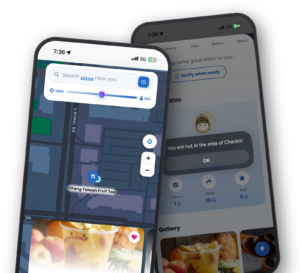
Instead of keeping customer data under lock and key, GOTYOU grants small businesses a platform to view all of their customers’ data. Anyone who walks through your doors can check in, leave a review, and complete a survey on the app. Customer information is then transmitted directly to the business, bypassing filters from Google and Meta. That data now belongs to you.
As a business owner, you can now advertise promotions, discounts, or any other offers to users on the app. You don’t have to worry about hoping that the advertisement will reach your target audience, because the audience on GOTYOU is the people walking in through your doors.
Our app highlights local businesses in your area, so you don’t have to worry about customers having to find you on Google Maps. We streamline all local companies that have GOTYOU directly through the app, providing easy access for people looking for a particular product.
Gone are the days of renting data from big tech. When it comes to small business owners owning it for themselves, we’ve got you.